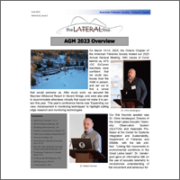
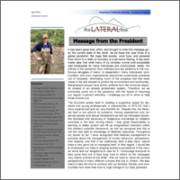
2023 AFS-OC AGM Overview
Student Subunit Update
2022 NCD-AFS Best Chapter Communications Award
Fish Focus – Golden Redhorse – Siobhan Ewert
Pictures of Fishes – Kathryn Peiman
Book Review – Effective Conservation: Parks, Rewilding, and Local Development by Ignacio Jiménez
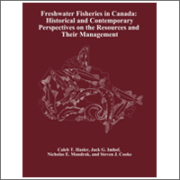
New Publication – Freshwater Fisheries in Canada
https://www.afs-oc.org/wp-content/uploads/2023/06/V211.png200200Roberthttps://www.afs-oc.org/wp-content/uploads/2024/11/AFS24_long.pngRobert2023-06-26 20:58:582024-07-03 22:21:46Volume XXI, Issue I – The Lateral Line
Canada is surrounded by three oceans and home to more freshwater lakes and rivers than can be reasonably counted. It is therefore not surprising that Canada has a plethora of freshwater fisheries and a long history of use and innovative strategies for managing them.
Freshwater Fisheries in Canada: Historical and Contemporary Perspectives on the Resources and Their Management (https://doi.org/10.47886/9781934874707) is designed to follow a logical arc beginning with an overview of the Canadian landscape and the zoogeography and status of freshwater fish populations. Next, the book brings together reports on fisheries from across Canada—either at the provincial or regional scale (as dictated largely by ecoregion; e.g., the North, the Laurentian Great Lakes). Then, a number of issues and threats are presented that are useful in revealing the challenges and opportunities that exist for ensuring that freshwater fish populations are healthy and vibrant. We conclude with some reflective contributions, including short essays from some legendary fisheries professionals in Canada as well as a forward-looking piece by some early-career fisheries professionals. Taken together, this book will serve as a resource for those interested in learning about the past, present, and future of freshwater fishes and fisheries in Canada.
https://www.afs-oc.org/wp-content/uploads/2023/06/FFIC.png200200Roberthttps://www.afs-oc.org/wp-content/uploads/2024/11/AFS24_long.pngRobert2023-06-09 13:10:522024-06-19 21:19:25Freshwater Fisheries in Canada: Historical and Contemporary Perspectives on the Resources and Their Management
After a very successful Wave 2 Engagement, DFO’s Fish and Fish Habitat Protection Program (FFHPP) is ready to undertake the next wave of engagement. FFHPP’s Wave 3 Engagement is seeking input to continue modernizing and/or developing policies, frameworks, instruments, and guidance to further implement the fish and fish habitat protection provisions of the Fisheries Act.
A video presentation overviewing the Wave 3 engagement plan is now available on the Talk Fish Habitat platform. Read more
https://www.afs-oc.org/wp-content/uploads/2010/03/dfo.gif200200Roberthttps://www.afs-oc.org/wp-content/uploads/2024/11/AFS24_long.pngRobert2023-03-29 14:03:522024-04-02 19:36:07News – DFO Fish and Fish Habitat Protection Program Wave 3
Fish and Fish Habitat Protection Program (FFHPP) Codes of Practice specify procedures, practices or standards for avoiding the death of fish or the harmful alteration, disruption or destruction of fish habitat. This is in relation to works, undertakings and activities during various phases of their life cycle, such as construction, operation, maintenance or decommissioning. Read more
https://www.afs-oc.org/wp-content/uploads/2010/03/dfo.gif200200Roberthttps://www.afs-oc.org/wp-content/uploads/2024/11/AFS24_long.pngRobert2022-11-15 09:18:302023-11-16 20:47:34News – Finalization of FFHPP Codes of Practice
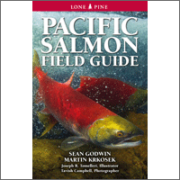
Pacific salmon are of immense cultural, ecological and economic importance to the west coast of North America. They are the most commonly seen fish on the western side of North America but identifying among the seven species is difficult for most of their life stages. Two salmon researchers have worked extensively in the field with this iconic group of fish and have developed the first comprehensive field identification guide for Pacific salmon in a functional format. This guide presents information and identifying characteristics for the seven Pacific salmon species—Sockeye, Coho, Chinook, Pink, Chum, Steelhead and Coastal Cutthroat—across five life stages, with strong emphasis on detailed and intuitive illustrations.
This guide is an identification resource that includes natural history, life stage descriptions and conservation status of Pacific salmon and how to observe these fish in the wild. The identification portions are organized into five life stages: fry, smolt, post smolt, ocean adult and spawner. The many scientific illustrations for each species are drawn from real specimens representative of their species and life stage. Joseph Tomelleri, who drew all the brilliant illustrations in this book, painstakingly measured every part of each fish, counting every fin ray and row of scales while layering colour upon colour. In addition, dozens of photos show these fish in incredible detail.
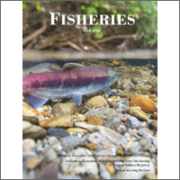
Sander Oken 1817 (Percidae) is the Valid Generic Name for Walleye, Sauger, and European Pikeperches: A Response to Bruner (2021)
AUTHORS: Christopher Scharpf, The ETYFish Project, 4102 Westview Road, Baltimore, MD 21218, USA. chris@etyfish.org; Ronald Fricke, Staatliches Museum für Naturkunde, Stuttgart, Germany. ronald.fricke@smns-bw.de
CITATION: Scharpf C. and R. Fricke. 2021. Sander Oken 1817 (Percidae) is the Valid Generic Name for Walleye, Sauger, and European Pikeperches: A Response to Bruner (2021). Fisheries 47(4)151:153 https://doi.org/10.1002/fsh.10686Read more
https://www.afs-oc.org/wp-content/uploads/2022/04/F474.png200200Roberthttps://www.afs-oc.org/wp-content/uploads/2024/11/AFS24_long.pngRobert2022-04-23 14:04:542023-05-07 13:51:21News – Sander is the Valid Generic Name for Walleye, Sauger, and European Pikeperches
President’s Message – Sarah Steele
2022 AFS-OC AGM Synopsis
Student Subunit Update – Jacob Burbank
Fish Focus – Blackside Darter – Siobhan Ewert
Diversity and Inclusion – Sarah Steele
Lake Ontario’s Lost Seal Population – Brian Morrison
Fish Species Complexity – Deep water spawning Lake Trout – Shawn Sitar
E.J. Crossman Award: Looking Back and Reconnecting with Awardees – Warren Dunlop
Bi-national Research – Ed Roseman
Book Review – A Sand County Almanac and Sketches Here and There – Gavin Charles
Native Species Art – Craig Paterson
Biologist Highlight – Bill Gardner
https://www.afs-oc.org/wp-content/uploads/2022/04/V201.png200200Roberthttps://www.afs-oc.org/wp-content/uploads/2024/11/AFS24_long.pngRobert2022-04-17 12:48:502023-05-07 13:51:12Volume XX, Issue I – The Lateral Line
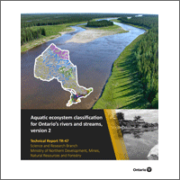
The Aquatic Ecosystem Classification (AEC) is a science-based tool used to classify Ontario’s rivers and streams based on their physical attributes (e.g., water temperature, turbidity, channel slope, upstream drainage area). The AEC reduces the complexity of these vast aquatic networks in Ontario by using consistent and quantitative methods to build a standardized data foundation that helps us understand and manage streams including landscape-scale planning and policy development. At the most basic level, we hope that people can derive expectations about the nature of a stream reach or segment without having to actually visit a stream.
https://www.afs-oc.org/wp-content/uploads/2022/04/AEC.png200200Roberthttps://www.afs-oc.org/wp-content/uploads/2024/11/AFS24_long.pngRobert2022-04-16 12:39:282023-04-28 09:43:00Aquatic Ecosystem Classification for Ontario’s Rivers and Streams, Version 2
After a very successful Wave One Engagement, DFO’s Fish and Fish Habitat Protection Program (FFHPP) is ready to undertake the next wave of engagement. FFHPP’s Wave Two Engagement is seeking input to continue modernizing and/or developing policies, frameworks, instruments, and guidance to further implement the fish and fish habitat protection provisions of the Fisheries Act.
The FFHPP Engagement Platform will house all engagement activities, provide participants with information and updates, and ensure all input and feedback will be directed to the FFHPP team.
Please visit the FFHPP Engagement Platform to register to participate in platform activities, and find new opportunities to participate, share, collaborate, and learn.
https://www.afs-oc.org/wp-content/uploads/2010/03/dfo.gif200200Roberthttps://www.afs-oc.org/wp-content/uploads/2024/11/AFS24_long.pngRobert2022-01-15 09:27:512023-10-20 09:37:52News – DFO Fish and Fish Habitat Protection Program Wave 2 Launch