Archive of Morphological Data for the Coregonus artedi Species Complex of the Great Lakes, Lake Nipigon, and Great Slave Lake

Archive of Morphological Data for the Coregonus artedi Species Complex of the Great Lakes, Lake Nipigon, and Great Slave Lake is a user guide for an archive of morphological data recorded by various authors from North American ciscoes of the Coregonus artedi species complex (subfamily Coregoninae). The archive is accessible from the Great Lakes Fishery Commission’s (GLFC) server, is open access, and contains data for the Laurentian Great Lakes; Lake Nipigon, Ontario; and Great Slave Lake, Northwest Territories. The archive comprises morphometrics and meristics (together metrics) for 6,700 individual Cisco of which 1,400 are accompanied by images. In addition, the archive contains metrics presented as arrays by W. N. Koelz, Coregonid fishes of the Great Lakes, Bulletin of the U.S. Bureau of Fisheries 43(2):297-643, which were based on 10,000 individuals. Spreadsheets in the Metrics folder of the archive are divided broadly into Contemporary and Historical subfolders and the Contemporary subfolder is further divided into Cisco Monograph and Extra Monograph subfolders to encourage statistical assessment of findings in GLFC Miscellaneous Publication 2023. The Images folder is organized into subfolders by lake. Tables in this user guide allow for quick determination of the availability of data by lake, subspecies, author, and year.

All Too Clear: Beneath the Surface of the Great Lakes

All Too Clear uses cutting-edge underwater drones to explore how quadrillions of tiny invasive mussels are re-engineering the ecosystem of North America’s Great Lakes at a scale not seen since the glaciers. The mussels are trapping nutrients, the building blocks of life, on the lake bottom. Without nutrients, organisms of all kinds – from the tiniest plankton to the largest fish – are vanishing, creating vast biological deserts. While the consequences for nature and people are severe, the loss of life has had an extraordinary side effect: it’s made the lakes far clearer than they’ve ever been before. We’ve harnessed this newfound clarity to capture animal behaviours and freshwater environments that have never been filmed before.

All 3 “All Too Clear” episodes are now streaming Canada-wide on TVO Today Docs.

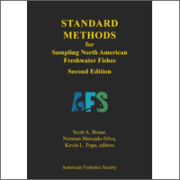
Standard Methods for Sampling North American Freshwater Fishes, second edition

Standard Methods for Sampling North American Freshwater Fishes, second edition provides standard sampling methods recommended by the American Fisheries Society for assessing and monitoring freshwater fish populations in North America. Methods apply to ponds, reservoirs, natural lakes, and streams and rivers containing cold and warmwater fishes. Range-wide and eco-regional averages for indices of abundance, population structure, and condition for individual species are supplied to facilitate comparisons of standard data among populations. Provides information on converting nonstandard to standard data, statistical and database procedures for analyzing and storing standard data, and methods to prevent transfer of invasive species while sampling.

Read more

AFS-OC Comments on Recovery Strategy and Action Plan for the Redside Dace

The Ontario Chapter of the American Fisheries Society (AFS-OC)  has provided comments on the Recovery Strategy and Action Plan for the Redside Dace (Clinostomus elongatus) in Canada prepared by Fisheries and Oceans Canada (DFO). Although the comment period for the Recovery Strategy has passed, it is hoped that this information will be used to update recovery measures and their priority ranking, an aim stated in the Recovery Strategy. View AFS-OC Comments.

Volume XXII, Issue I – The Lateral Line

HIGHLIGHTS:

2024 AFS-OC AGM & Conference Summary
Student Subunit Update
Diversity and Inclusion – Sarah Steele
Redside Dace ESA Letter
Fish Focus – Iowa Darter – Siobhan Ewert
Book Review – A Clouded Leopard in the Middle of the Road: New Thinking about Roads, People, and Wildlife. By Darryl Jones
Books by Ontario Biologists
2024 AFS-OC AGM Sponsors

Download

AFS-OC Expresses Concern Regarding Proposed Changes to ESA Redside Dace Habitat

The AFS-OC would like to express its concern with the December 20, 2023 proposed changes to the Endangered Species Act by the Ministry of the Environment, Conservation and Parks (MECP) which will impact Redside Dace in Ontario. As a result we have drafted a letter expressing our concerns, questions and potential solutions to alert our membership. In short, we ask concerned members to visit https://ero.ontario.ca/notice/019-8016 and review the proposed regulatory changes, and submit comments. If you are unsure about what to say, we list possible issues you can copy in the attached letter. The more voices that oppose this change, the better.

NOTE that questions or comments must be submitted before February 20, 2024.

Regulatory changes to the Endangered Species Act

Ontario protects species at risk and their habitats through the Endangered Species Act, 2007 (ESA).

As part of efforts to improve the effectiveness and implementation of the species at risk program, amendments are proposed to several regulations made under the ESA.

Specifically, amendments are proposed in four key areas:

  1. Regulatory amendments regarding habitat protections for Redside Dace
  2. Regulatory amendments regarding select conservation fund species and related administrative changes
  3. Regulatory amendments to add newly listed species to existing conditional exemptions and other administrative changes to conditional exemptions
  4. Regulatory amendments regarding the conditional exemption for early exploration mining

Feedback and input from the public, Indigenous communities, and stakeholders on these proposed changes are invited. This consultation closes at 11:59 p.m. on February 20, 2024. See https://ero.ontario.ca/notice/019-8016 for more information.

Let’s Go for a Swim! Aquatic Species at Risk in Ontario, Prairies and Arctic

Let’s Go for a Swim! Print and colour some aquatic species at risk in Ontario, Prairies and Arctic, including Grass Pickerel, Spotted Gar, Lake Sturgeon, Redside Dace, Bigmouth Buffalo, and more.

Aquatic Species at Risk Ontario, Prairies, and Arctic
The Ontario and Prairie Region of Fisheries and Oceans Canada (DFO) includes Alberta, Saskatchewan, Manitoba, and Ontario, while the Arctic Region includes the Yukon North Slope, Northwest Territories, Nunavut, Nunavik, Nunatsiavut, and Hudson and James Bay. This boundary is inclusive of Inuit Nunangat. The purpose of Canada’s Species at Risk Act (SARA) is to conserve, protect and recover Endangered or Threatened species, and to encourage the management of species of Special Concern to prevent them from becoming further at risk. The Act aims to prevent indigenous species from becoming extirpated or extinct and preserve biodiversity within Canada.

Not all aquatic species at risk in Canada are shown in this book. For more information, including critical habitat and distribution data for all aquatic species listed under SARA, check out DFO’s National Aquatic Species at Risk Map.

Volume XXI, Issue II – The Lateral Line

HIGHLIGHTS:

President’s Message – Erik Tuononen
2024 AFS-OC AGM & Conference
Student Subunit Update
Changes to Ontario Fish Names – Rob Eakins
Barrier Mitigation Workshop – Brian Morrison
Snorkelling for Fish – Sarah Steele
New Record of Spotted Gar – Nathan Lujan, Mary Burridge, Brenna Wells
Wil Wegman Tribute – Kate Gee, Eva Bobak
Book Review – Swamplands: Tundra Beavers, Quaking Bogs, and the Improbable World of Peat by Edward Struzik
Fish Focus – Brassy Minnow – Siobhan Ewert

Download

Changes to Ontario Fish Names 2023

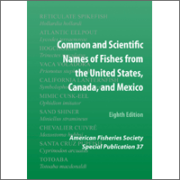
Several changes to Ontario fish names have occurred according to Common and Scientific Names of Fishes from the United States, Canada, and Mexico. 8th Edition. For details see Changes to Fish Names 2023.