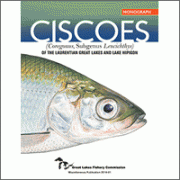
Following a nearly four-year team effort at analysis and writing, the Great Lakes Fishery Commission announces publication of Ciscoes (Coregonus, subgenus Leucichthys) of the Great Lakes and Lake Nipigon. This report, styled as a monograph, is available in PDF now and will soon be printed for field use. Read more
https://www.afs-oc.org/wp-content/uploads/2017/05/Ciscoes.gif200200Roberthttps://www.afs-oc.org/wp-content/uploads/2024/11/AFS24_long.pngRobert2017-05-05 21:12:452021-03-31 00:15:27A Monograph on Ciscoes of the Laurentian Great Lakes and Lake Nipigon
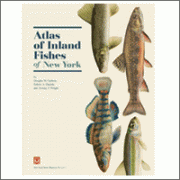
The updated Atlas of Inland Fishes of New York is now available. The Atlas offers current data, distribution, mapping and illustrations of all New York’s 181 freshwater fish species.
https://www.afs-oc.org/wp-content/uploads/2016/05/NYSAtlas.gif200200Roberthttps://www.afs-oc.org/wp-content/uploads/2024/11/AFS24_long.pngRobert2016-05-03 13:21:342023-03-30 17:58:31Atlas of Inland Fishes of New York
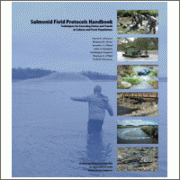
State of the Salmon joined forces with public, tribal and private organizations along with individuals around the North Pacific to identify and articulate the best available salmon monitoring practices. We gathered these principles and tools into the Salmonid Field Protocols Handbook: Techniques for assessing status and trends in salmon and trout populations (https://doi.org/10.47886/9781888569926).
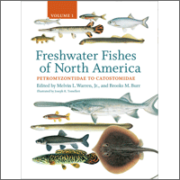
Edited by Melvin L. Warren Jr. and Brooks M. Burr. Illustrated by Joseph R. Tomelleri.
2014
Published by: Johns Hopkins University Press
A monumental reference that provides comprehensive details on the freshwater fishes of the United States, Canada, and Mexico. Certain to stand among the reference books of choice for anyone interested in the continent’s aquatic ecosystems, Freshwater Fishes of North America covers the ecology, morphology, reproduction, distribution, behavior, taxonomy, conservation, and fossil record of each North American fish family. Volume 1 (of three) covers the following North American families of fishes: Petromyzontidae (Lampreys), Dasyatidae (Whiptail Stingrays), Acipenseridae (Sturgeons), Polyodontidae (Paddlefishes), Lepisosteidae (Gars), Amiidae (Bowfins), Hiodontidae (Mooneyes), Anguillidae (Freshwater Eels), Engraulidae (Anchovies), Cyprinidae (Carps and Minnows) and Catostomidae (Suckers). Read more
https://www.afs-oc.org/wp-content/uploads/2023/04/FFNA-1.png200200Roberthttps://www.afs-oc.org/wp-content/uploads/2024/11/AFS24_long.pngRobert2014-08-11 23:57:082023-04-12 00:04:46Freshwater Fishes of North America: Volume 1: Petromyzontidae to Catostomidae
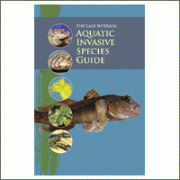
Lake Superior has extraordinary aquatic life, supported by cool coastlines, pristine islands, diverse coastal wetlands, extensive sandy beaches, and the coldest and deepest waters in the Great Lakes. It is the world’s largest freshwater lake by area. Lake Superior has a relatively simple food web, which means it is especially vulnerable to damage from invasive species.
https://www.afs-oc.org/wp-content/uploads/2014/08/LS-AISG.gif200200Roberthttps://www.afs-oc.org/wp-content/uploads/2024/11/AFS24_long.pngRobert2014-08-09 17:43:032021-12-01 15:34:42The Lake Superior Aquatic Invasive Species Guide
Guidelines for the Use of Fishes in Research (https://doi.org/10.47886/9781934874394) aids researchers and regulatory authorities regarding responsible, scientifically valid research on fish and aquatic wildlife. The document is intended to provide general recommendations on field and laboratory research, such as sampling, holding, and handling fishes; to offer information on administrative matters, including regulations and permits; and to address typical ethical concerns, such as perceptions of pain or discomfort experienced by experimental subjects.
https://www.afs-oc.org/wp-content/uploads/2014/08/Guidelines.gif200200Roberthttps://www.afs-oc.org/wp-content/uploads/2024/11/AFS24_long.pngRobert2014-08-09 15:44:132026-09-13 10:59:09Guidelines for the Use of Fishes in Research
Common and Scientific Names of Fishes from the United States, Canada, and Mexico, 7th edition (https://doi.org/10.47886/9781934874318) provides an accurate, up-to-date checklist of common and scientific names for all described and taxonomically valid fish species living in fresh and marine waters of North America. This edition reflects numerous taxonomic changes that have occurred since 2004 and includes 3,875 species and 260 families. Provides the rationale and methodology for common name allocation, history of changes from the previous edition, and extensive references. Also includes Spanish and French names. Compiled in cooperation with the American Society of Ichthyologists and Herpetologists.
https://www.afs-oc.org/wp-content/uploads/2013/04/Fish-Names-2014.gif200200Roberthttps://www.afs-oc.org/wp-content/uploads/2024/11/AFS24_long.pngRobert2013-04-15 19:11:012026-09-13 19:24:03Common and Scientific Names of Fishes from the United States, Canada, and Mexico, 7th edition
This document has been prepared to assemble information on the live bait industry in Ontario prior to a policy review of live bait management in the province. Various types of live bait are described and the feasibility of aquaculture for different bait species is investigated. Licence sales, reported harvests, and economics are provided for the Ontario bait industry. Management of the Ontario bait industry is reviewed. Results of a North American jurisdictional scan on bait policies and management practices are presented. Finally, problems and issues currently facing the bait industry are identified.
https://www.afs-oc.org/wp-content/uploads/2014/03/bait.gif200200Roberthttps://www.afs-oc.org/wp-content/uploads/2024/11/AFS24_long.pngRobert2013-04-06 19:10:282021-03-30 23:56:31The Management of Bait in Ontario: A Review
This report has been prepared in an attempt to identify events of significance to fisheries managers and detail how fisheries management has evolved over the past 200 years. It is a mixture of history, anecdotes, and factual information.
https://www.afs-oc.org/wp-content/uploads/2014/03/fish_man.gif200200Roberthttps://www.afs-oc.org/wp-content/uploads/2024/11/AFS24_long.pngRobert2013-04-06 19:10:032021-03-31 00:00:09Fish and Fisheries Management in Ontario: A Chronology of Events
An annotated and illustrated catalogue of lamprey species known to date – FAO Species Catalogue for Fishery Purposes No. 5 by Claude B. Renaud of the Canadian Museum of Nature Ottawa, Canada. This catalogue provides an account for each of the 39 species. Each species account gives information on the taxonomy including synonyms, common names, diagnostic features of ammocoetes and adults (with drawings of the adult body and oral disc), habitat and biology, geographic distribution (with map), interest to fisheries and references. Read more
https://www.afs-oc.org/wp-content/uploads/2014/03/FAO_5.gif200200Roberthttps://www.afs-oc.org/wp-content/uploads/2024/11/AFS24_long.pngRobert2012-04-06 19:04:582021-01-08 11:42:29Lampreys of the World