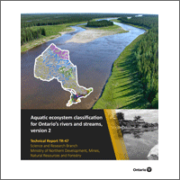
Aquatic Ecosystem Classification for Ontario’s Rivers and Streams, Version 2

The Aquatic Ecosystem Classification (AEC) is a science-based tool used to classify Ontario’s rivers and streams based on their physical attributes (e.g., water temperature, turbidity, channel slope, upstream drainage area). The AEC reduces the complexity of these vast aquatic networks in Ontario by using consistent and quantitative methods to build a standardized data foundation that helps us understand and manage streams including landscape-scale planning and policy development. At the most basic level, we hope that people can derive expectations about the nature of a stream reach or segment without having to actually visit a stream.

Read more

Annotated Checklist of Fishes of Thunder Bay District

This first edition of Checklist of Fishes of Thunder Bay District adds to existing checklists prepared by members of the Thunder Bay Field Naturalists (TBFN) covering other vertebrate taxa (mammals, birds, reptiles & amphibians), as well vascular plants, butterflies, and odonates. As with these other checklists, it covers the official judicial District of Thunder Bay which extends from the eastern border of Quetico Provincial Park east to White River, and from the international border north to Lake St. Joseph and the Albany River. Much of the District (60%) is within the Great Lakes watershed, with the remaining draining into the Arctic Ocean either north via the Hudson Bay Lowlands, or west via Rainy Lake/Lake of the Woods and the Nelson River watershed.

Read more

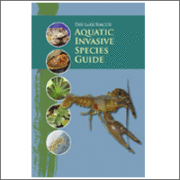
The Lake Simcoe Aquatic Invasive Species Guide

With an area of 722 km2 and inflow from 35 major rivers and streams, Lake Simcoe is an important source of biodiversity for the southern Ontario region.  The lake and surrounding watershed, which span across 20 municipalities, are home to a wide variety of aquatic and non-aquatic life, including 75 species of warm and coldwater fish, and many provincially rare species-at-risk.

Read more

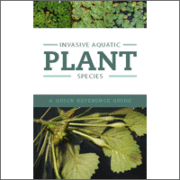
Invasive Aquatic Plant Species: A Quick Reference Guide

Invasive Aquatic Plant Species: A Quick Reference Guide was compiled and written by the Ontario Federation of Anglers and Hunters Invading Species Awareness Program.  Support for the development of this guide was provided by the Ontario Ministry of Natural Resources and Forestry.

This publication is available for download in PDF format.

Guidance on the Use of Targeted Environmental DNA (eDNA) Analysis for the Management of Aquatic Invasive Species and Species at Risk

Guidance on the Use of Targeted Environmental DNA (eDNA) Analysis for the Management of Aquatic Invasive Species and Species at Risk

By Cathryn Abbott, Mark Coulson, Nellie Gagné, Anaïs Lacoursière‐Roussel, Geneviève J. Parent, Robert Bajno, Charise Dietrich and Shannan May-McNally.

Analysis of DNA from environmental samples (i.e., environmental DNA or eDNA) is increasingly being used as a non-intrusive, sensitive, and often cost-effective biological monitoring approach, either on its own or to complement other methods. Due to the numerous promising applications of eDNA, there has been significant recent growth in eDNA research and development; however, the complexity and rapid evolution of related methodologies has created challenges for resource managers when deciding how to apply eDNA technologies to inform decision making.

Read more

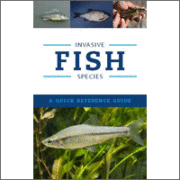
Invasive Fish Species: A Quick Reference Guide

The Invasive Fish Species: A Quick Reference Guide was compiled and written by the Ontario Federation of Anglers and Hunters Invading Species Awareness Program.  Support for the development of this guide was provided by the Ontario Ministry of Natural Resources and Forestry.

This publication is available for download in PDF format.

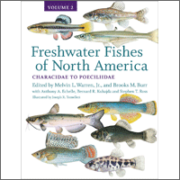
Freshwater Fishes of North America: Volume 2: Characidae to Poeciliidae

Edited by Melvin L. Warren Jr. and Brooks M. Burr with Anthony A. Echelle, Bernard R. Kuhajda, and Stephen T. Ross. Illustrated by Joseph R. Tomellerii.
2020
Published by: Johns Hopkins University Press

The highly anticipated second volume of Freshwater Fishes of North America, a monumental, fully illustrated reference that provides comprehensive details on the freshwater fishes of the United States, Canada, and Mexico. When the first volume of Freshwater Fishes of North America was published, it was immediately hailed as the definitive reference in the field. Readers have been fervently awaiting the next volume in this encompassing three-book set ever since. Now complete, volume 2, covering families Characidae to Poeciliidae, is the result of decades of analysis by leading fish experts from universities and research laboratories across North America. Read more

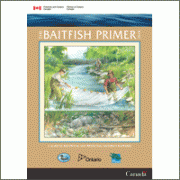
The Baitfish Primer: A Guide to Identifying and Protecting Ontario’s Baitfishes (2018 Revision)

The Baitfish Primer (2018 revision) was authored by by Becky Cudmore and Nicholas E. Mandrak and jointly produced by Fisheries and Oceans Canada, Ontario Ministry of Natural Resources and Forestry, Bait Association of Ontario and Ontario Federation of Anglers and Hunters.

Read more

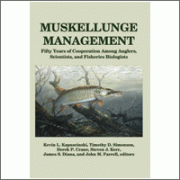
Muskellunge Management: Fifty Years of Cooperation Among Anglers, Scientists, and Fisheries Biologists

This book represents the state-of-the-art in our understanding of Muskellunge biology, ecology, and management, and is a must-read for anyone studying or managing this iconic species. Readers will benefit from the latest information on a novel, non-lethal method for sampling contaminants in Muskellunge, how angler-scientist partnerships have enhanced management actions, how genetic tools have improved our understanding of this species, and population-level responses to management actions and outbreak of viral hemorrhagic septicemia.

Read more

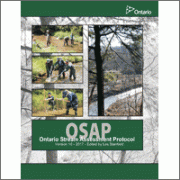
Ontario Stream Assessment Protocol Manual (Version 10)

The Ontario Stream Assessment Protocol (OSAP) contains a series of standardized methodologies for identifying sites, evaluating benthic macroinvertebrates, fish communities, physical habitat and water temperatures in wadeable streams. The OSAP provides standardized methods that ensure data repeatability.  Use of these standard methodologies allow data to be shared, used for multiple purposes and stored in a common database. Download a PDF copy of the OSAP Manual Version 10, updated April 2017, from Toronto and Region Conservation.

Read more