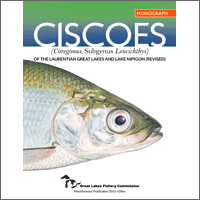
A Monograph on Ciscoes of the Laurentian Great Lakes and Lake Nipigon (Revised)
The Great Lakes Fishery Commission publication of Ciscoes (Coregonus, subgenus Leucichthys) of the Great Lakes and Lake Nipigon (2016) was recently revised. The report was revised to provide corrected snout lengths for the 2015 collections of albus-like from Lakes Huron and Michigan, Appendix Tables 14 and 15. The revised report (July 2023) is available in PDF.
Ciscoes historically were the dominant consumers of zooplankton throughout the Great Lakes. Comprising eight main forms, this complex provided critical links in food webs between invertebrates and top predators like Lake Trout and Walleye. Ciscoes also supported wide-ranging commercial fisheries. One form of cisco inhabited upper waters and was predominant. The other seven forms all inhabited deep water and were marketed as chubs.
The new monograph represents an update of a study by Walter Koelz, published in 1929. He was the first to systematically describe the forms and document their life history. His field studies, conducted aboard commercial fishing boats, lasted from 1917 to 1924, and encompassed 14,000 specimens—a colossal undertaking. Many of his specimens are archived at the University of Michigan Museum of Zoology, where he once worked.
The diversity of ciscoes documented by Koelz did not persist long after the completion of his studies. In fact, the two largest forms in Lake Michigan were approaching extirpation even while he collected. The cause was intensive fishing with gillnets that selectively removed the largest forms, allowing the smaller forms to proliferate. This situation worsened when the sea lamprey invaded the Great Lakes and preferentially preyed on the largest forms, compounding the problem.


